Sir Charles Chaplin…

For the Love of Charlie…

For the Love of Charlie…


Charles Spencer Chaplin – Dear Charlie Chaplin! 


Dear Charlie became Sir Charles Chaplin, receiving his knighthood from Her Majesty Queen Elizabeth II at Buckingham Palace in 1979. His film career had spanned 54 years, and in that time Charlie made a total of 81 films, only 5 were talkies and 67 were completed before his 30th birthday. Sadly Charlie died at the good age of 88 and on Christmas Day in 1977 at his home in Vevey, Switzerland; at his bedside were Oona his fourth wife, their children, and grandchildren.


Hannah Chaplin was Charles Mother and she had spent most of the later years of her life at an institute in England and for her remaining seven years she lived in the little house Charlie had bought for her close to the Pacific Ocean. Sidney Chaplin (Sid) was Charlie’s older brother and manager, he had retired to the South of France after the second world war and visited every summer with Charlie in Switzerland.


The first love in Charlie’s life was Hetty Kelly. He had fell in love with her whilst working for Fred Karno. But alas! when he left for a USA tour she married a politician and later died from influenza at the very young age of 25. Charlie never forgot her and she was the inspiration for many of his screen heroines. Charlie had a leading lady in Edna Purviance for over 30 comedies, and when she retired after failing to make a new career as a dramatic actress Charlie had her kept on the studio payroll for the rest of her life. Charlie’s first wife was a very young Mildred Harris. After their sudden divorce she was reduced to working in sleazy nightclubs and died an alcoholic at the age of 43. Charlie’s second wife was Lita Grey and they had two sons – Charlie Chaplin Jnr, and Sidney Chaplin. Charlie Chaplin Jnr died in 1968.


Paulette Goddard – formally Levy, was a famous star, and became Charlie’s third wife. When she retired from acting in 1966 and divorced from Charlie, she and her new husband set up home in Switzerland not far from Charlie’s house. Joan Barry was besotted by Charlie. She was a flirt and a drunk and followed Charlie around everywhere. After their affair ended she claimed he was the father of her child. But a blood test (not admissible in a California Court at the time) proved otherwise. However Charlie supported Joan’s daughter Carol Anne until she reached the age of 21. Poor Joan, unfortunatly spent much of her remaining life sectioned before dying at an early age.  


Oona O’Neil Chaplin was 18 when she consented to marry Charlie. She had been a former Irish debutant and together they had eight children. She did survive Charlie by some 14 years and she had always loved him with a passion until her own death in the September of 1991.  


Posted in Patrick's Words | Tagged | Leave a comment

Enid Stamp Taylor – Actress… A Profile

Enid Stamp Taylor – Actress 1904 – 1946  Enid was born in Percy Avenue, Whitley Bay, during the early hours of the 12th of June 1904. She lived most of her adult life in the West End of London, and where she suffered from a blood clot in her brain whilst in the bathroom of her Park Lane apartment in the cold January of 1946. Three days later she passed away at the Atkinson Morley hospital in Wimbledon and was buried in the secluded and peaceful grounds of Alfold Parish Church… and that’s perhaps, where my story began…

Posted in Patrick's Words | Tagged | 1 Comment

Maryon Park…

 Maryon Park, Woolwich, London

Maryon Park was the main setting for the 1966 Michelangelo Antonioni’s cult movie ‘Blow-Up’ featuring David Hemmings and Vanessa Redgrave. David Hemmings played Thomas, a top London fashion photographer captivated by his photographs of a murder, whilst Vanessa Redgrave is the woman at the centre of his interest. His photographs depict a murder scene… or do they? What you see, and what you don’t see, is the enigma central to the story. My photographs taken in 1998 show a park that has changed little in 32 years, the upper meadow where the supposed murder took place is a bit run-down now, but the lower meadow still has its original tennis courts used in the movie, and much of the scenery is unchanged. Beyond the courts there is a hedge now, the flower beds have been altered since the movie, and there is perhaps a little more litter around, but to be fair… a school party had just left from having a picnic when I arrived!  http://twitpic.com/photos/patricallaghan3

Posted in Patrick's Words | Tagged | 2 Comments

Whisky Galore…

It was in the summer of 1948 when the Ealing crew arrived on the beautiful Island of Barra in the Western Isles of Scotland. Michael Balcon, head of Ealing Studios had not been happy about the production, saying as he looked at the story board, he just did not understand it!  “It holds few laughs” he was heard to comment. Based on a Compton Mackenzie novel, shooting almost entirely on location presented huge problems, everything, including cast and crew, and a huge amount of camera equipment, had to be shipped from mainland Scotland. Actors were billited with a number of the Islanders, and in fact, many of the inhabitants appear in the production. Their view of the film people was… That they were quite mad! Prefabricated sets were constructed at Ealing Studios in London then shipped for assembly on Barra. Under the brilliant direction of Alexander Mackendrick, an American born Scot, the film gently eases you into a world of warmth, gentilityand innocent skulduggery. It think this was partly due to Mackendrick’s insistence on being present during every scene, however, this did push the budget over by 20,000, and in those days that was a lot of money…as Michael Balcon soon pointed out, and when he saw the rushes he hated it, and ordered the film to be cut and released as a B’ supporting picture! At this point, Mackendrick asked Charles Crichton, a top editor, if he would look at the negatives. He did… And Recut, and Recut… the result was a more acceptable product for the Ealing Studio boss. Being based on a true maritime sinking means that some facts had to be changed. The real sinking took place off the Isle of Eriskay, and the local Islanders did profit from their huge haul of ‘Scotch’… Unlike the movie that had to deal with the moral issue. In America the movie was given a new title and called “Tight Little Island” because a number of States were at the time ‘Temperance’  If one looks at the stills today Alexander Mackendrick is always there beside the camera operator, and I think, that is what made it such a lasting and enduring, warm and attractive film.

Posted in Patrick's Words | Tagged | Leave a comment

The Aldwych Ghost Station…


The Aldwych Subway Station is a ghost station, built in 1907 as The Strand, it closed its doors to passengers for the last time in 1994… Standing now, on its deserted platform deep below London’s busy streets, I can sense the long-forgotten sounds of opening subway train doors and hurried conversations. I can almost feel those desponding souls living here below ground during those dark and distant days of the second world war. Wartime posters still cling to the walls all around me, and I feel any moment that a roar and bustle will emerge from the dark to penetrate my isolation… But then shaking somewhat and with a sudden inexplicaple cold sweat I tread the upward narrow stairway and thrust myself into the cool fresh London air with gulpfuls of thankfulness, my modern-day fears not welcomed in the dark confines of a terrorised wartime England.

Posted in Patrick's Words | Tagged | Leave a comment

The Night Caller…

‘The Night Caller’… Armitage Films 1965. Still, after all this time, has some very scary moments! The title shot of The Thames is evocative! It features John Saxon (later to work in the US), Maurice Denham, and Patricia Haynes – I fell in love with her!… I just adore tall beautiful women… Later she appears in a ‘TV Steptoe’ Also has David Gregory and Romo Gorrara – two favorites of mineRomo went on as a stunt actor –both established hands from many a Butcher Film!  And of course the velvet soft tones of John Carson lend an air of quiet authority. (John retired to South Africa after many British Film appearances) Very decisive is the performance of Alfred Burke, who from 1965-1975 became a household name as Frank Marker in the popular TV series of Public Eye… Alfred is still with us… at the golden age of 92! The Night Caller is available on DVD from Amazon. Some title releases: The Night Caller from Outer Space 1966.

Posted in Patrick's Words | Tagged | Leave a comment

Bletchley Park… And Lunch!


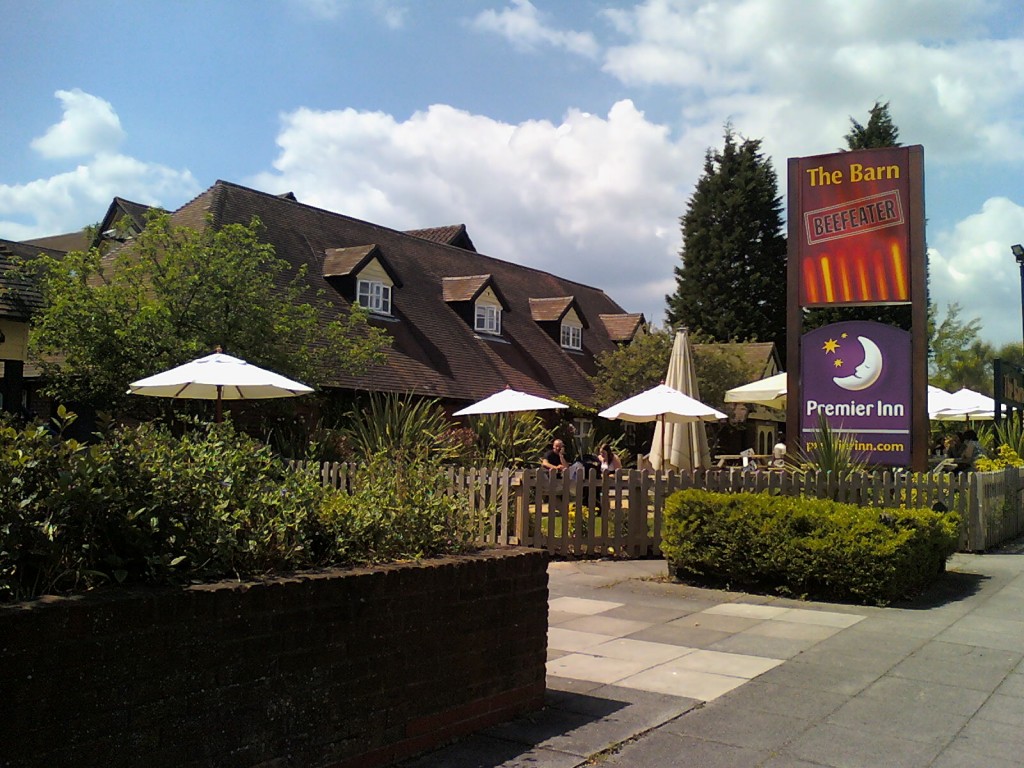
The Barn at Milton Keynes The Barn at Milton Keynes
 Yes, The Barn provided Marilyn and me with an excellent lunch once more on our Saturday visit to Bletchley Park near Milton Keynes. Bletchley Park was the subject of my earlier blog and the home of Britain’s wartime codebreakers. It’s an excellent day-out for all the family, it’s enjoyable and fun, and you learn something of modern history. If you can’t get there, they are online with a first class website that gives you the feel of the park @ www.bletchleypark.org.uk

Posted in Patrick's Words | Tagged , , | Leave a comment

Bletchley Park… Home of the Codebreakers

Bletchley Park near Milton Keynes England was a secret for over 30 years. Once it was Britains best kept secret. The Enigma cipher machine was developed and used here during the second world war to break the German codes. It was very successful and believed to have shortened the war by around two years, saving countless lives.

Today the park is open to the public as a heritage site and museum, and Marilyn and I explored the wide range of exhibitions and learnt how its codebreaking successes worked. More incredible than fiction, the story of Bletchley Park was a desperate race against time. The mission of codebreakers like Alan Turin, was to crack Germany’s coded communications, such as those sent via the German Enigma machine. Bletchley Park was Churchill’s secret passion; he called the codebreakers his “Geese that laid the golden eggs but never cackled” 8.500 people worked at Bletchley Park during the war and all done with amazing secrecy.

Colossus was on view; this was the world’s first semi-programmable electronic computer and developed for Bletchley Park. The size of a small room, it used over 2,500 valves, and the rebuilt version is operational today.

Bletchley Park was the world’s first large-scale codebreaking centre, and there is much to see and do there. Marilyn and I enjoyed our day, visiting the Mansion House, a number of well-staged exhibitions, the fine Cafe, and the codebreaking huts. The Park is situated in a beautiful parkland setting, with a lake, wildlife and an American Garden Trail commemorating the special relationship formed here.

Bletchley Park is online @ www.bletchleypark.org.uk

Posted in Patrick's Words | Tagged , , | Leave a comment

Enid Stamp Taylor… And friends

‘Rex and Biz’

Enid Stamp Taylor... and friends

Enid Stamp Taylor… And friends!

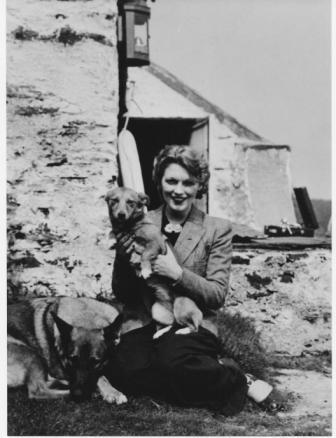
Enid and two cherished companions on holiday at Portmeirion North Wales in the August of 1937. I thought it would be nice to open-up this cold January of 2011 with a bright and breezy summer shot of Enid Stamp Taylor. The holiday village of Portmeirion was the setting for the famous TV series of ’The Prisoner’ starring Patrick McGoohan. Enid is pictured snapped by family members ‘The Poritts’… The architect Clough Williams-Ellis was the brainchild behind ‘Portmeirion’ – the Italianate village known as ‘The Xanadu of Wales’…  and it’s likely he was a friend to Enid.

Posted in Patrick's Words | Tagged , , , | Leave a comment

More of Mitchell and Kenyon…

Found in the basement cellar of a shop in Blackburn Lancashire England were over 800 short films of Edwardian life in the North of England. They were made by the partnership of Sagar Mitchell and James Kenyon and the films they shot were of local people and events. It is a remarkable glimpse into history. They made the films to be shown at the Music Hall, Town Hall, or Fairgrounds. They were made for commercial reasons with the sole intention of putting ‘bums on seats’ after all, for people to see themselves on a projected screen was something new and quite wonderful!


Between 1897 and 1913 Mitchell and Kenyon made hundreds of short films depicting the everyday lives of ordinary people, and when the business closed its doors in the nineteen twenties their original negative film stock was left hidden away in the basement of the shop. Here it lay for years simply collecting dust until 1994 when a building contractor found three large metal drums containing hundreds of Mitchell and Kenyon films. The films were passed to a local film historian who in turn gave them to the British Film Institute Archives in Hertfordshire.

The film stock was nitrate, very delicate, and highly flammable, although the coolness of the basement must have helped to preserve the material from utter decay. The films were brittle, but the originals were painstakingly re-photographed onto modern film stock, a process that took around three years. They now form one of the largest collections of early non-fiction films in the world.

Kenyon had originally made penny slot-machines, and Mitchell had been a stills photographer. At the time they set-up in business together the moving image was the hi-tec of its time. Many of their films show people leaving work and putting as many faces on the screen as possible was their aim, after all, this was a paying public! They could watch themselves in showings at the Music Hall, Town Hall, or local Fairground. Mitchell and Kenyon would hand out lealets telling of the showing times and where, and saying “See Yourselves As Others See You”

Mitchell and Kenyon did also show the prosperous side of Edwardian life in visiting other larger towns and cities with their camera and they also made a number of rather stilted dramas that were less accepted by the public who really loved their ‘local’ films.

Posted in Patrick's Words | Tagged | Leave a comment